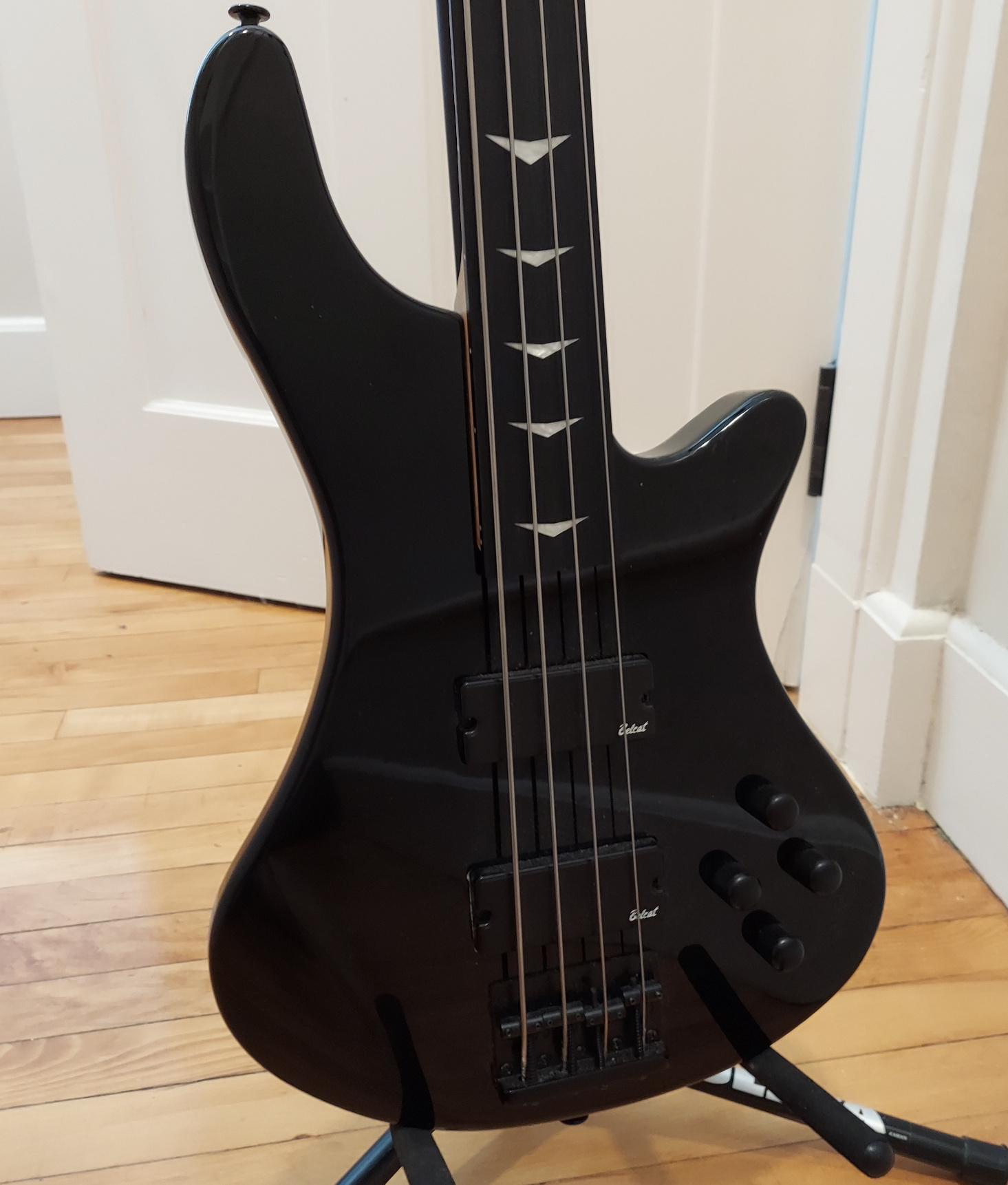
I’ve been playing bass for 60 years and I’m also an electronics tech. I recently went down a rabbit hole trying to understand why impedance matching actually works the way it does — not just “high-Z in, low-Z out,” but the actual mechanism. What I found along the way changed how I think about my whole signal chain, and I think a lot of players are missing this.
The Impedance Problem
Your passive pickup is a coil of thousands of turns of thin wire. That’s not a design choice — it’s just what it takes to sense string vibration magnetically. But thousands of turns of thin wire also means high electrical resistance, whether you want it or not. Players often look at a pickup's spec sheet and see 6,000–15,000+ ohms. That is the DC resistance, but it is not the whole story. Because that wire is wrapped into a coil, it acts as an inductor. As the pitch of the guitar signal goes up, so does the pickup's output impedance—easily reaching hundreds of thousands of ohms. At 100 Hz (a low E), your bass's output impedance might be around 10k ohms. But at 4 kHz (the harmonics that give you your "clank" and definition), that impedance spikes to over 200k ohms. This high impedance is why passive pickups struggle to drive long cables or low-impedance inputs without losing their life and tone.




What Gets Missed
Here’s the trap. An amplifier downstream will restore your volume, hiding the fact that your tone was compromised upstream. "Loud and fine" is not the same as "your full tone made it through." In audio, there is a golden rule for bridging impedance: the input of the next device should be at least 10 times greater than the output of the previous one. If your bass's impedance is 200k ohms at high frequencies, it needs to see an input of 2 Megohms to pass those highs cleanly. I have an AKG HP4E headphone amp in my chain with a fixed line-level input and no gain-adjust knob. I recently realized that its low input impedance was quietly stripping the highs off my signal before amplifying what was left. It sounded fine. It just wasn’t capturing all of the tone available from my bass.
Where the fix actually belongs
A buffer is a simple active circuit — needs power (typically a 9V battery) — that does exactly one job: it takes in your fragile, high-impedance pickup signal without loading it down, and sends out a low-impedance copy that can drive cables and gear without loss. No EQ, no tone shaping, no “sound.” Just impedance conversion.
You can buy pedals and DI boxes that buffer your signal (SansAmp-style DI boxes, buffer pedals, etc.), and those absolutely help. But here’s the thing that changed my mind: your cable is part of the problem too. A standard instrument cable has real capacitance, and a passive high-Z signal traveling down 10–15+ feet of cable is already losing some top end before it ever reaches that buffer pedal on your board.
If the buffer lives inside the bass — right after your pickups’ volume/tone/blend circuitry, immediately before the output jack — your signal leaves the instrument already converted to low impedance. The cable run, the pedal board, whatever’s downstream: none of it can degrade a signal that’s already been protected at the source. Everything after that point is working with your actual tone, not a partially-compromised version of it.
What this looks like in practice
There are simple, no-frills options built exactly for this — nothing more than the impedance fix, no added EQ. The Bartolini AGB/918-2 is one example: single-channel adjustable-gain buffer, 9V or 18V operation, mounts in the control cavity, battery-powered. You wire it in after your existing volume/tone/blend pots (they stay completely stock and passive) and before the jack, so it only touches the final combined signal on its way out.
A couple of practical notes if you go this route:
- 9V vs 18V just affects headroom before clipping on hard transients (slap, aggressive picking). 9V is plenty for most players.
- Mount the battery so it’s replaceable — don’t glue or silicone it in. A hook-and-loop strip or simple battery pouch works fine and saves you from a destructive swap later.
- A buffer doesn’t fix hum or noise. That’s a shielding problem (copper foil tape or conductive shielding paint in the cavity) — totally separate from impedance. Do both if you’re after quiet and full-bandwidth tone.
- If you’re on a P/J-style passive bass with no pickup switch and you’re getting more hum running one pickup solo, that’s likely RWRP hum-cancellation losing effectiveness when you’re not blending both pickups — a wiring characteristic, not something shielding or a buffer will resolve.
Bottom line
If you’re happy with your pickups’ native tone, controls, and everything about your passive bass — the cheapest, least invasive thing you can do to protect that tone is stop it from ever being exposed to a bad impedance match in the first place. Put the buffer where the signal starts, not somewhere downstream trying to catch what’s already been lost.